
Area & Volume formulas are one of the most important topics in Mathematics, especially for CBSE exams, competitive exams, and quick revision before tests.
In this blog, you will find a clear and easy Mensuration Formula Chart covering 2D shapes (Area) and 3D solids (Volume).
At Edu-Spot, our aim is to make learning simple, clear, and effective.
What is Mensuration?
Mensuration is the branch of mathematics that deals with the measurement of area, volume, and surface area of different geometric shapes.
Area → Space covered by a 2D shape
Volume → Space occupied by a 3D solid
🔷 Area Formulas (2D Shapes)
1. Square
Area = a²
(a = side)
2. Rectangle
Area = l × w
(l = length, w = width)
3. Triangle
Area = ½ × b × h
(b = base, h = height)
4. Circle
Area = πr²
(r = radius, π ≈ 22/7)
5. Parallelogram
Area = b × h
6. Trapezium
Area = ½ × (a + b) × h
(a, b = parallel sides)
7. Rhombus
Area = ½ × d₁ × d₂
(d₁, d₂ = diagonals)
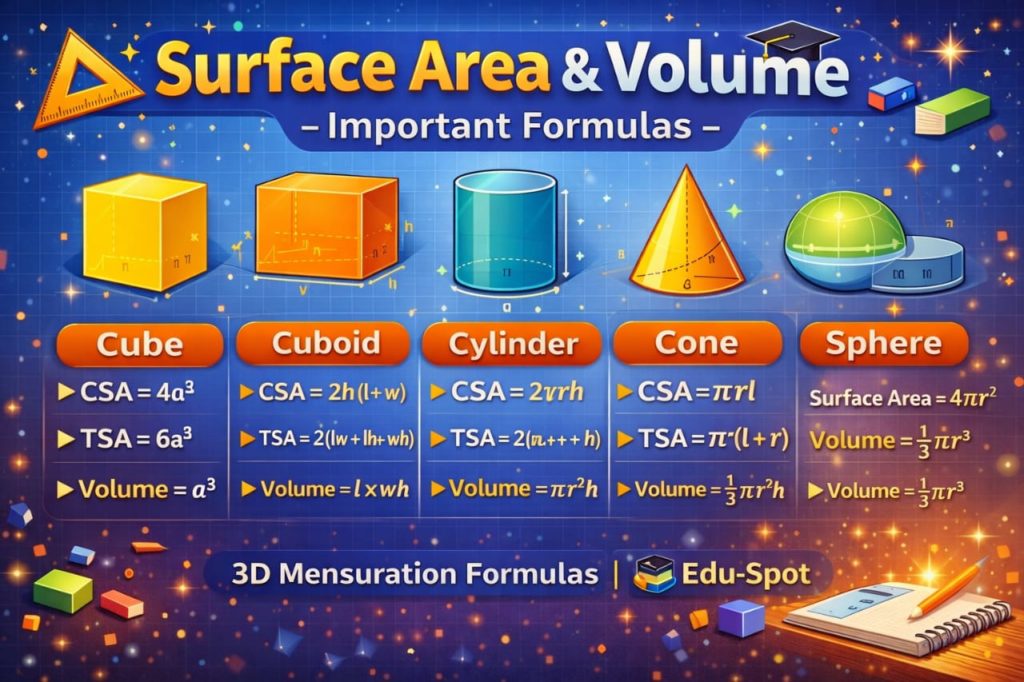
Surface Area and Volume Formulas (3D Solids)
🔹 1. Cube
Curved Surface Area (CSA) = 4a²
Total Surface Area (TSA) = 6a²
Volume = a³
(a = side)
🔹 2. Cuboid
CSA = 2h(l + w)
TSA = 2(lw + lh + wh)
Volume = l × w × h
(l = length, w = width, h = height)
🔹 3. Cylinder
CSA = 2πrh
TSA = 2πr(r + h)
Volume = πr²h
(r = radius, h = height)
🔹 4. Cone
CSA = πrl
TSA = πr(l + r)
Volume = ⅓ πr²h
(l = slant height)
🔹 5. Sphere
Surface Area = 4πr²
Volume = ⁴⁄₃ πr³
🔹 6. Hemisphere
CSA = 2πr²
TSA = 3πr²
Volume = ⅔ πr³
📝 Important Exam Tips
✔ Always write units (cm², m², cm³, m³)
✔ Use π = 22/7 unless mentioned otherwise
✔ Draw a diagram before solving
✔ Check whether CSA or TSA is asked
🎯 Why Surface Area & Volume is Important?
High-weightage chapter in exams
Based on real-life applications
Easy scoring with formula practice
Builds strong geometry foundation